Over the past couple of years, our coaches have noticed a new topic being discussed in their sessions: long weekend rides, gravel routes, and hill repeats. Plenty of our clients have caught the cycling bug – and almost as quickly, they’ve started asking how their strength training should fit around it.
It’s a great question to be asking. Cycling is fantastic for your heart, lungs, and head – it gets you outside, it’s low impact, and it can be as sociable or as solitary as you like. But it also asks your body to repeat the same movement thousands of times, in the same seated position, with very little load going through your bones.
That’s where strength training for cyclists comes into play. Here, we’ll look at what the research says, what strength work actually does for riders, and how to build it into your week without making your legs too sore for Sunday’s ride.
Should Cyclists Lift Weights?
For a long time, weight training for cyclists was seen as optional at best – something for track sprinters rather than endurance riders. But the short answer is yes, and the evidence for it has become hard to ignore.
A 2025 systematic review and meta-analysis pooled 17 studies of endurance cyclists who added heavy strength training to their riding. Strength training improved cycling performance in time trials and time-to-exhaustion tests, along with cycling efficiency and anaerobic power – the short, hard efforts you need for a climb, a sprint, or closing a gap.
Interestingly, it didn’t change VO2max. That’s worth understanding: strength training isn’t a replacement for riding, and it won’t build your aerobic engine for you. What it does is help you use that engine better.
It isn’t a brand-new idea, either. An earlier review of strength training for runners and cyclists found that the most compelling evidence for strength work boosting endurance performance was in cycling.
It’s only fair to mention the limits. Most of the studies are small, and the reviewers rated the overall certainty of the evidence as low. But the results point consistently in the same direction – and the other benefits below don’t depend on shaving seconds off a time trial.
What Strength Training Does for Cyclists
More Power From Every Pedal Stroke
When your leg muscles are stronger, each pedal stroke takes a smaller share of your maximum effort. Researchers think this is part of why strength training improves efficiency – your body can rely on its more fatigue-resistant muscle fibres for longer, and save the less efficient ones for when you really need them.
In practical terms, that can mean reaching the top of a climb with a little more in reserve, and having something left for the last hour of a long ride.
Stronger Bones
This is the benefit that surprises most riders. Because cycling is non-weight-bearing, it does very little to load your skeleton. A systematic review of cycling and bone health found that adult road cyclists who train regularly tend to have low bone mineral density in key areas, including the lower spine and hips – and the effect was clearest in competitive riders and those who’d been training for years.
The authors’ conclusion was clear: cycling on its own isn’t enough for anyone at risk of osteoporosis unless it’s combined with training that loads the bones. Lifting weights – and, once you’re ready, some jumping exercises – is exactly that kind of training.
A More Robust Body for Long Rides
Hours in a fixed, forward-leaning position can take a toll on your hips, lower back, and neck, and plenty of riders end up with sore knees or a grumbling lower back.
Strength training can’t fix a badly set-up bike. But a stronger core, glutes, and upper back make it easier to hold a good position for longer, and help your body cope with bigger training weeks. If you already have pain that isn’t going away, get it checked by a physiotherapist first – then our injury-aware personal training can help you build back from there.
Staying Strong as You Get Older
Cycling is a sport people stay in for decades, which makes strength even more important with age. From middle age onwards, we gradually lose muscle and bone unless we give our bodies a reason to hold on to them – and riding alone doesn’t provide that.
As we explain in How to Protect Muscle and Bone as You Age, resistance training is the go-to tool for keeping both. Whether you’re in your 30s or a cyclist over 50 or 60, that means more power on the bike – and more resilience off it, if you ever do take a tumble.
Won’t Lifting Weights Make Me Heavier?
It’s a very common worry among riders, and it’s understandable when every kilo counts on a climb.
In reality, building a lot of muscle takes a large amount of focused training and plenty of extra food. Two strength sessions a week alongside regular riding isn’t a recipe for bulk.
The goal for cyclists is to get strong, not big. Much of the early progress from heavy, low-rep training comes from your nervous system learning to use the muscle you already have – and improved neuromuscular efficiency is one of the reasons researchers give for strength training helping cyclists in the first place.
What Is a Good Strength Workout Routine for Cyclists?
The best routine is one that suits your experience, your riding goals, and your body – which is why we always build it around the person in front of us. But the best gym exercises for cyclists tend to share the same ingredients:
A squat pattern – goblet squats to start with, progressing to barbell back squats or leg press. These build the quads and glutes that drive the pedals.
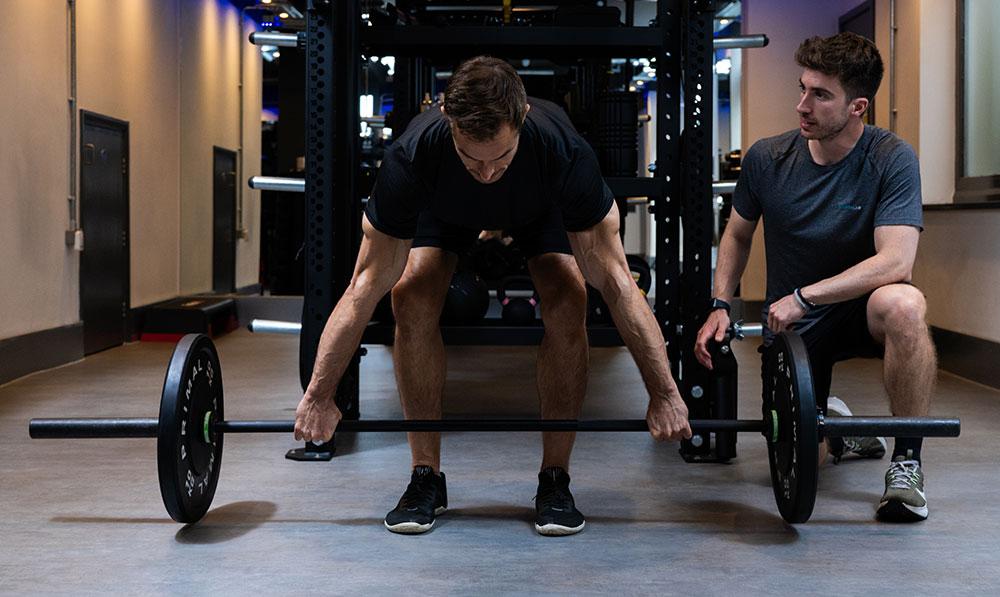
A hip hinge – Romanian deadlifts or deadlifts, to strengthen the hamstrings, glutes, and lower back that hold you in position.
Single-leg work – split squats, step-ups, or single-leg leg press. You pedal one leg at a time, so it makes sense to train that way, and it helps even out any imbalances.
Calf raises – simple, but a regular feature of the strength programmes used in cycling studies.
Upper body pulling and pushing – rows and press-ups, for a stronger back and shoulders on long rides and rough gravel.
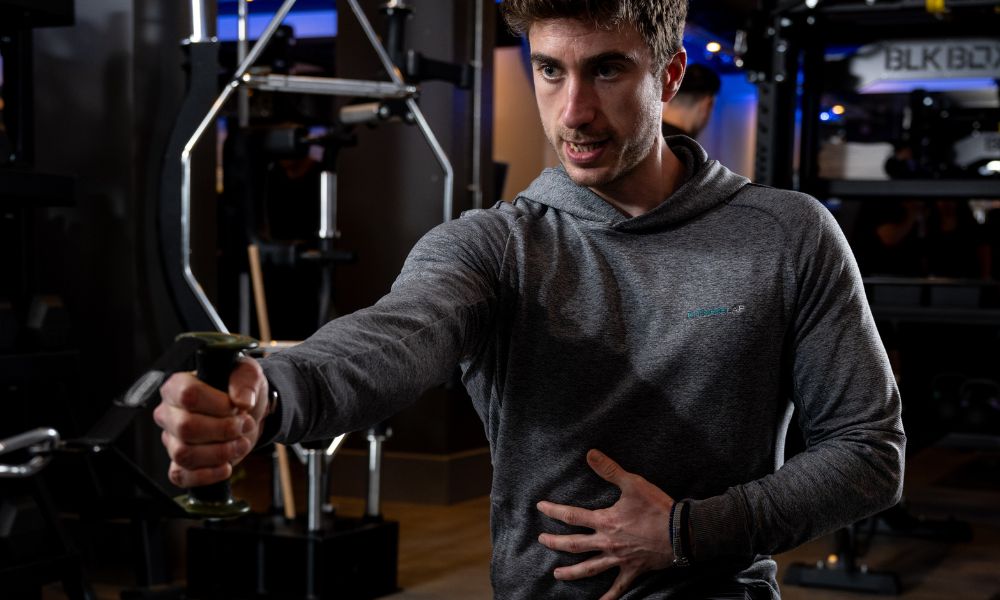
Core exercises that resist movement – planks, dead bugs, and Pallof presses rather than endless crunches. On the bike, your core’s job is to keep you stable while your legs do the work.
For the main lifts, we’d usually start with slightly higher reps – around 8 to 10 – while you learn the movements, then gradually move towards heavier weights for fewer reps, typically in the 4 to 6 range. The studies in the 2025 review mostly used heavy loads – roughly the weight you could lift about seven times – for three or four sets.
Once you’ve built a solid base, some explosive work like box jumps or jump squats can be added for power and bone health. As we explain in our guide to strength training for runners, though, it’s important not to rush into it: jumping puts a lot of stress on joints and tendons that aren’t ready for it.
How Does a 12-Week Strength Training Programme for Cyclists Work?
The studies in the 2025 review ran for an average of around 14 weeks, with just over two sessions a week – so a 12-week block is a sensible place to start. Here’s roughly how one might look:
Weeks 1-4: learn and build. Two full-body sessions a week, with moderate weights and 8-10 reps, focusing on technique and getting comfortable with each movement.
Weeks 5-8: get stronger. The weights go up and the reps come down towards 5 or 6 on the main lifts, with single-leg and core work alongside.
Weeks 9-12: heavy and powerful. Heavier sets on the key lifts, with some explosive exercises added if you’re ready for them.
After that, the job is to keep what you’ve built. In one study of well-trained cyclists, riders who lifted twice a week for 12 weeks and then dropped to one session a week kept their gains in strength and thigh muscle through the first 13 weeks of their racing season.
Every programme should be adjusted to the individual, though. A 12-week plan for someone new to the gym will look very different from one for someone who’s been lifting for years.
Fitting Strength Training Around Your Riding
For most cyclists, the biggest challenge isn’t the lifting itself – it’s the timing. A few simple rules help:
Build strength in the quieter months. Autumn and winter, when rides tend to be shorter and the weather is worse, are the ideal time for two heavier sessions a week.
Drop to maintenance when riding ramps up. Once your big rides and events start, one session a week is usually enough to hold on to your strength.
Protect your key rides. Avoid heavy leg sessions the day before a long ride, an event, or a hard interval session.
Expect some heavy legs at first. It usually settles within a few weeks as your body adapts – which is a good reason to start conservatively.
Your coach can plan all of this around your riding calendar, so your sessions support your goals on the bike rather than getting in the way of them.
Where Does Mobility Fit In?
Strength isn’t the whole picture. Plenty of riders feel stiff after a long day in the saddle. And if you spend your working week at a desk, your hips and upper back are probably folded into much the same shape for most of the day as they are on the bike. So it’s worth giving mobility some thought too.
Before a ride, keep things moving rather than holding still. Leg swings, walking lunges, a few hip circles and an easy first ten minutes of pedalling will prepare you better than long static stretches. A review of the stretching research found that holding a stretch for a minute or more per muscle just before exercise could take the edge off performance, while shorter holds made much less difference.
After a ride is a better time for slower, longer stretches, if you enjoy them. They can feel good and help your flexibility over time. It’s worth knowing, though, that a Cochrane review found stretching does very little for next-day soreness, so don’t worry if you skip it now and then.
Then there’s the rest of your day. One idea that’s catching on is the “movement snack”: a few minutes of gentle movement, once or twice a day, to break up long spells of sitting. Get up from your desk, do a few rounds of cat-cow on the floor, follow it with a cobra stretch, and that’s it. Five minutes is plenty. There’s no single “correct” posture to hold, so the aim isn’t to sit perfectly. The aim is to avoid staying in any one position for hours at a time, and moving the opposite way for a few minutes often leaves people feeling much less stiff by the time they get on the bike.
Road or Gravel – Does It Change Anything?
The fundamentals are the same whichever bike you ride, but there are a few differences worth thinking about.
Road riding tends to mean long, steady hours in a fixed position, so a strong core, glutes, and upper back pay off for comfort and posture. Gravel adds rougher surfaces, more bike handling, and more short, punchy efforts – so upper body strength, grip, and single-leg power earn a bigger place in the programme.
Final Thoughts: Stronger Riders Ride Better
If you’ve fallen for road or gravel cycling, strength training is one of the best things you can add to your week. It won’t replace your time on the bike – but it can help you get more out of it, protect your bones, and keep you riding comfortably for years to come.
At Fitness Lab, our coaches can build strength and conditioning programmes around your goals and your riding calendar, in private 1-1 studio space in Marylebone, Mayfair, Soho, and Fitzrovia. Whether you’re preparing for your first sportive or just want to feel stronger on the climbs at the weekend, we’ll help you build a plan that fits.
If you’d like to talk it through, a free, unrushed consultation is a great place to start. Complete the form at the bottom of the page, and we’ll be in touch.