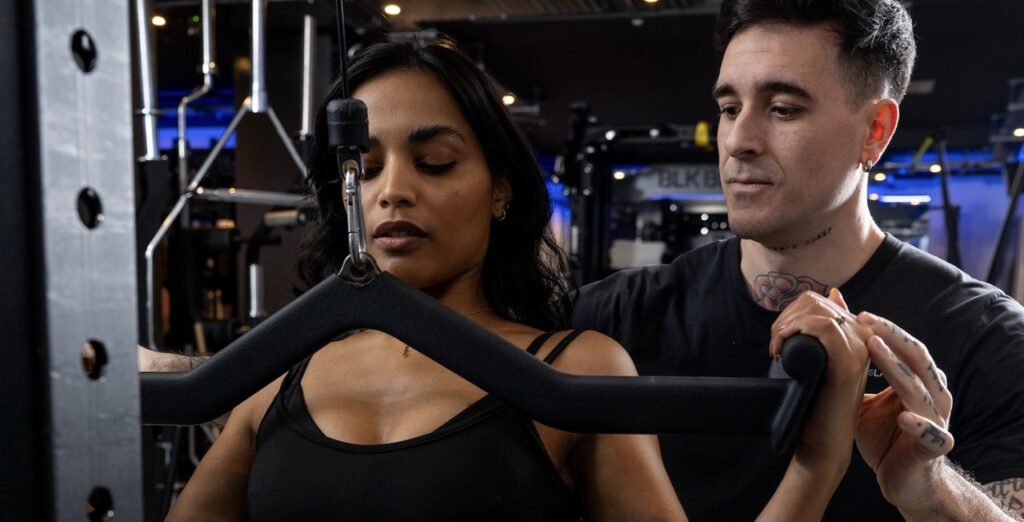
When people think about private personal training, they often picture a one-to-one session between a client and a coach. While this kind of one-to-one training is definitely the most personalised option, it’s not the only way to work with a trainer.
At Fitness Lab, clients are welcome to train two-to-one with their coach. That might mean a spouse or romantic partner, a friend, a sibling, or even a colleague who wants to work towards similar health goals. Sessions still run for one hour, just like standard personal training, but the coach works with both individuals at the same time.
For many people, this setup offers a fantastic balance of professional guidance, accountability, and shared motivation. However, like most things in fitness, there are a few considerations worth understanding before deciding whether it’s the right option for you.
So, when it comes to personal training for couples, what are the advantages, what are the limitations, and how does it actually work in practice?
What Is Personal Training for Couples?
Personal training for couples simply means two people sharing a session with one coach. Rather than training separately, both individuals attend the same one-hour session and follow a structured programme designed by the trainer.
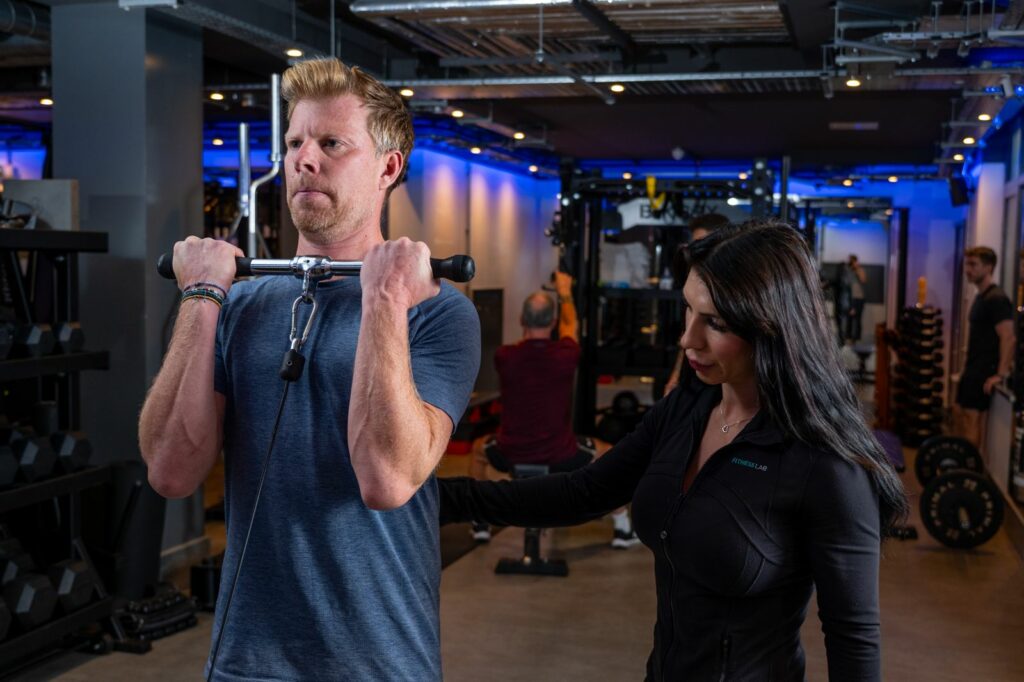
Despite the shared environment, a good coach will still tailor exercises to each individual. For example, one person may perform a heavier squat variation while the other works on a scaled-down version of the exercise (known in fitness terms as a ‘regression’) better suited to their strength level or mobility.
This means that in practice, sessions often run as a structured rotation. One person might perform a set while the other rests or completes a complementary exercise, allowing the coach to supervise both effectively and safely.
Although most people choose one-to-one training, we do have a number of clients at our Mayfair, Soho, and Fitzrovia locations who choose to train this way and feel like it makes the process of starting and maintaining a fitness routine more enjoyable or accessible for them personally.
Why Many People Prefer Training Together
Starting a fitness journey alone can feel intimidating. Although we do everything we can to make the experience stress and pressure-free, walking into a training environment for the first time, learning unfamiliar movements, and pushing physical limits all require a certain level of confidence.
Training alongside someone you already know can make the process feel far more comfortable. It introduces an element of shared experience, which often helps people stay consistent long enough to see real results.
That said, the benefits of couples training go well beyond simply having company in the gym.
Advantages of Personal Training for Couples
- Shared accountability – It’s much harder to skip a session when someone else is expecting you to show up. Couples often find consistency improves dramatically when they commit to training together.
- Greater confidence in the gym – For beginners in particular, having a familiar face alongside them can make the learning process feel less intimidating.
- Time efficiency – Rather than coordinating separate gym visits, both poeple can train within the same one-hour session. This is particularly useful for busy professionals.
- Motivation and healthy competition – Seeing someone else progress can be surprisingly motivating. A little friendly competition can encourage both participants to push themselves further.
- Shared lifestyle changes – Fitness progress rarely happens in isolation. When two people train together, they’re often more aligned with habits like regular exercise, improved nutrition, and better sleep routines.
From a psychological point of view, this kind of social reinforcement is really useful when it comes to making fitness a habit that sticks. Research in behavioural science consistently shows that people are more likely to stick with health-related behaviours when they involve social commitment and accountability.
In simple terms, if someone else is relying on you to turn up, you’re far more likely to follow through.
However, while couples training can be incredibly effective, it’s important to recognise that it does introduce some practical limitations.
The Potential Downsides (And Why Coaching Matters)
It’s worth being clear about this next point. While two-to-one training works extremely well for many people – it isn’t identical to one-to-one personal training, and understanding the differences helps set realistic expectations.
The most significant challenge comes down to individual progression.
In resistance training, one of the most important drivers of any kind of improvement is something called progressive overload. This principle simply means that over time, the body must be exposed to gradually increasing levels of stress – heavier weights, different types or numbers of repetitions, improved technique, or greater training volume.
When a coach works with a single client, they can adjust every detail of the session to match that individual’s ability, recovery, and progression rate.
With two people training together, this kind of progression becomes a little harder to get right in a way that keeps pace with both people.
Different Strength Levels
In many couples, one person may already have training experience while the other is relatively new to exercise. Strength levels, mobility, and confidence in the gym can vary significantly.
Our skilled coaches can adapt exercises to suit both individuals – for example by adjusting load, range of motion, or movement variations. However, the overall structure of the session still needs to accommodate both participants.
As a result, the session often progresses at the pace of the slower or less experienced participant.
This isn’t necessarily a problem, but it does mean that couples training works best when both people are comfortable progressing together rather than seeing the biggest possible change for themselves as an individual.
Different Goals
Another factor to think about is goal alignment.
One person might want to build muscle, while the other is primarily focused on weight loss or general fitness. These goals do overlap more than people think – resistance training, cardiovascular conditioning, and improved movement quality benefit almost everyone.

Still, subtle differences in programming may be needed. A coach will typically design the session so that both participants can pursue their goals within the same structure – but again, this will typically mean two people see slightly slower progression than they would if their coach were entirely focused on just one person.
The Reality: 2:1 vs 1:1 Training
Ultimately, the most important thing to acknowledge is this:
Two-to-one personal training will almost never be quite as individually optimised as one-to-one coaching.
For that to happen, both people would need to:
- Start at the same fitness level
- Have similar body mechanics
- Share identical goals
- Progress at exactly the same rate
In reality, that combination is extremely rare.
That said, the difference in effectiveness is often smaller than people expect, especially when sessions are well structured. For many clients, the increased motivation, consistency, and enjoyment of training together more than compensates for the slight reduction in individualisation.
And ultimately, consistency always beats perfection in fitness.
Who Couples Personal Training Works Best For
In practice, couples training tends to work particularly well in a few situations.
Friends who are both new to the gym often benefit from learning foundational exercises together. The shared experience makes the process less daunting and far more enjoyable.
Romantic partners frequently appreciate the ability to spend time together while improving their health, especially when busy work schedules limit opportunities for shared activities.
Colleagues or housemates sometimes train together simply because it makes scheduling easier and introduces a built-in accountability system.
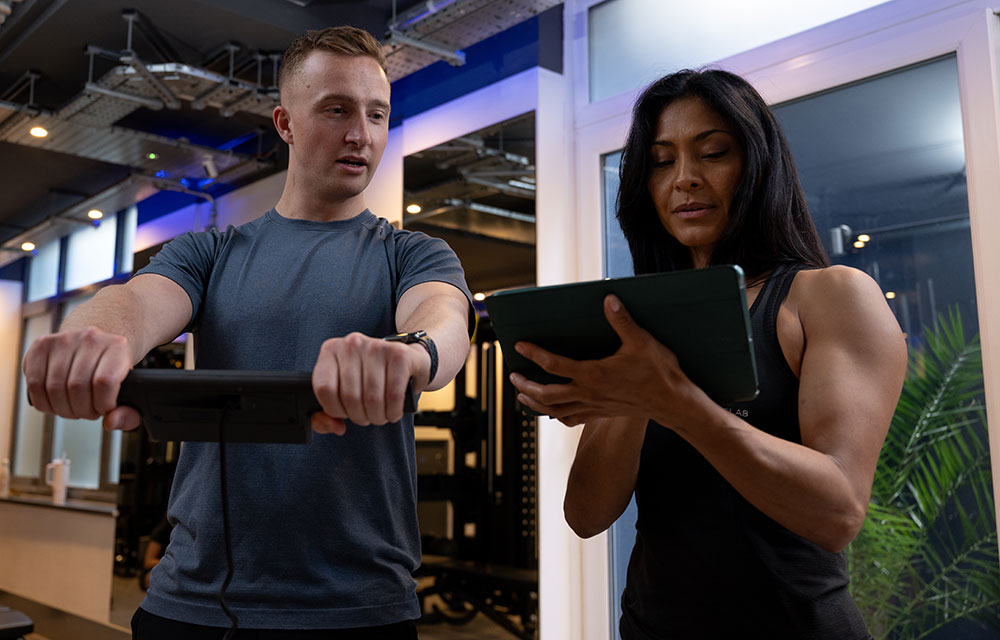
However, the key factor isn’t the relationship between the two people – it’s whether both individuals are comfortable training at a similar pace and supporting each other’s progress. If you are, couples training can be an extremely effective and sustainable way to stay active.
Frequently Asked Questions
Do couples pay double for personal training?
No. When two people train together at Fitness Lab, they do not pay double the cost of a standard session.
Instead, both individuals attend the same one-hour session and share the coaching time. This makes couples training a more cost-effective way to access professional guidance while still benefiting from structured programming and expert supervision.
Do we need to be the same fitness level?
Not necessarily. Most couples have different strength levels and training experience, and a good coach will adapt exercises accordingly.
For example, one person might perform a more advanced variation of a movement while the other focuses on a foundational version. The session structure remains shared, but the exercises can be adjusted to suit each participant.
Can couples have different fitness goals?
Yes, within reason.
Many fitness goals overlap more than people expect. Building muscle, improving body composition, increasing strength, and enhancing general fitness all share similar training foundations.
A coach can often design sessions that support both individuals’ objectives while maintaining a cohesive structure for the workout. If your coach feels like it wouldn’t be practical to work towards your goals together, they’ll be upfront about it and explain the limitations you might face.
Is couples’ personal training less effective than 1:1 training?
In purely technical terms, one-to-one training offers the highest level of individualisation.
However, effectiveness in fitness doesn’t depend on programming alone. Consistency, motivation, and long-term adherence play a far larger role in real-world results.
For many people, training with a partner significantly improves those factors, making couples personal training an excellent and sustainable option.
Personal Training for Couples: Final Thoughts
Personal training for couples offers a unique balance of professional guidance, shared motivation, and practical convenience. For many people, it transforms exercise from something that feels like a chore into an activity that becomes part of a shared routine.
There are certainly a few limitations to consider. Two-to-one training cannot provide the same level of individualisation as one-to-one coaching, particularly when participants have very different goals or experience levels.
However, when two people are happy to progress together and support each other’s development, the benefits can be substantial. Increased accountability, improved consistency, and a more enjoyable training experience often lead to long-term success.
And in fitness, long-term consistency is ultimately what produces real results.
If you’re curious about whether personal training for couples might be a good fit for you, the best approach is simply to talk it through. At Fitness Lab, you can arrange a free consultation to discuss your goals, explore how sessions would work, and determine whether training together is the right approach for your situation.