Ask someone who trains regularly what they get out of it, and the physical answers tend to come easily. They’ve added weight to their squat, dropped a jeans size, or finally managed a pull-up they’d been chasing for months. These are concrete, measurable things, and because the science behind them is well established, we can talk about them with real confidence.
The mental benefits are a different story. Ask about those, and the answers become softer and harder to pin down. People say they just feel better. They feel sharper at work, their mood seems lifted, they’re sleeping more soundly than they have in years. These benefits are every bit as real as the physical ones – in fact, for a great many people, they’re the main reason they keep working out. But there’s an interesting imbalance in how we describe them. We have numbers and milestones for the body, and little more than a shrug and a good feeling for the mind.
There’s a reason for that gap. Until relatively recently, the biology simply wasn’t well understood. We had some long-standing ideas, most of them centred on endorphins, but the fuller picture has only come into focus over the past decade or so.
Today, the science is increasingly pointing towards a group of molecules called myokines, and they offer a far more satisfying explanation for why training leaves you feeling the way it does. In this blog, we’ll take a deeper look at myokines, how the science has developed, the conditions myokines thrive in, and what it means for your brain.
What Happened to the Endorphin Theory?
For decades, the “endorphin rush” was the standard explanation for the lift you feel after exercise. It’s a tidy idea, and it has settled comfortably into everyday conversation. The problem is that it doesn’t hold up especially well when you look closely.
Endorphins are relatively large molecules, and the prevailing scientific view is that they struggle to cross the blood-brain barrier in any meaningful quantity. In simple terms, the endorphins circulating in your bloodstream after a workout aren’t necessarily the ones responsible for changing how your brain feels. The well-known “runner’s high” is now more often attributed to a different group of compounds called endocannabinoids, which can cross into the brain far more readily.

None of this means endorphins are irrelevant. It’s more that they were oversold – sold as the whole story when they were only ever a small part of it. Understanding what else is going on is actually a far more interesting part of that story.
Muscle as an Active Organ
Myokines are signalling molecules that your muscles release whenever they contract. To appreciate why this matters, it helps to understand how thinking about muscle has changed.
For a long time, muscle was regarded as fairly passive tissue. It held you upright, moved you around, stored a little glucose, and that was more or less the extent of its job description. We now know that’s a significant underestimate. Muscle is increasingly recognised as an active endocrine organ, which means it produces and releases hormones of its own. That shift in understanding is one of the more important developments in exercise science in recent years, and it changes how we think about what a workout actually does.
Today it’s understood that when you train, your muscles aren’t simply growing stronger – they’re also broadcasting chemical messages to the rest of the body. The brain, the immune system, fat tissue, the liver, the gut – all of them receive signals from working muscle, and those signals shape how you feel in the hours and days that follow.
The Molecules Worth Knowing
There are dozens of different myokines, and researchers are still discovering new ones. A handful, though, are particularly relevant to the way training affects your mood and mind, so they’re worth looking at in a little more detail.
BDNF (Brain-Derived Neurotrophic Factor)
The first is BDNF, or brain-derived neurotrophic factor. It’s sometimes described as ‘Miracle-Gro’ for the brain – which is a useful (if slightly strange) image. BDNF supports the growth of new neurons, strengthens the connections between existing ones, and is closely linked to memory, learning and mood regulation. Exercise has been shown to raise BDNF levels, and that helps explain the sharper, more switched-on feeling that often follows a good session.
Irisin
Then there’s irisin, a more recently identified myokine that has generated a lot of interest. Released during exercise, it appears to play a role in everything from fat metabolism to brain health, and researchers are actively exploring its potential protective effects against cognitive decline.
Interleukin-6 (or IL-6)
A third, interleukin-6 (or IL-6), is perhaps the most intriguing of the group, because it seems to contradict itself. Chronically elevated IL-6, of the kind associated with persistent inflammation, is bad for you. Yet the short, sharp burst of IL-6 released during exercise behaves in almost the opposite way: it’s anti-inflammatory and contributes to glucose regulation, fat oxidation and immune function. It’s the same molecule producing very different effects, and the difference comes down entirely to context.
…and Many Others
Beyond these three sit many others, with names like cathepsin B, decorin and various myostatin inhibitors. The list continues to grow as the research develops. But the headline point is the one to hold on to: when you train, your muscles aren’t just adapting in isolation. They’re effectively communicating with every major system in your body.
A Framework for Something You Already Felt
What’s so satisfying about this research is that it doesn’t overturn what people have long sensed. It explains it.

That clear-headedness after a session is, in part, BDNF doing its work. The lift in mood that lingers for hours is myokines influencing neurotransmitter activity. The deeper sleep on the nights you’ve trained reflects a more regulated nervous system, supported by the same signalling. The reduced anxiety, the steadier response to stress, the sense that you can cope with a little more of what the day throws at you – these are the result of myokine activity, and importantly, they can be measured in research settings rather than only described as a feeling.
This matters because the mental benefits of exercise are so easily dismissed as vague or secondary. In reality, they are neither – they simply hadn’t been mapped properly until recently. The instinct that training makes you feel better was always correct; we now have a much clearer sense of the machinery behind it.
Do You Have to Work Out Harder to Benefit from Myokine Influence?
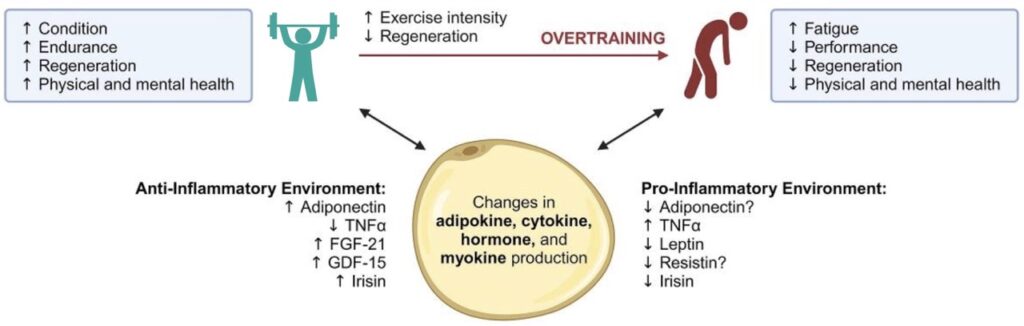
In short – no. The release of these beneficial molecules isn’t proportional to how punishing your workout was. In fact, harder workouts might even reduce the effect of myokines.
So, you don’t need to drag yourself out of a session barely able to walk in order to benefit. In fact, training that leaves you utterly depleted can sometimes blunt the response, because it pushes cortisol – your principal stress hormone – too high for too long. The sweet spot is steady, sensibly programmed strength training: enough to prompt the signalling, but not so much that your recovery is overwhelmed and the advantage is lost.
(Image adapted from: NIH.gov)
This fits closely with how we think about training more broadly. The aim was never to punish yourself into better health. It’s to do the right amount, consistently, in a way that fits comfortably around your life, and to allow the benefits to accumulate over time. The myokine research, in its own way, is simply biological confirmation of an approach built on sustainability rather than spectacle.
What It All Adds Up To
The next time the conversation turns to what exercise really does for you, it’s worth remembering that the mental side is no longer a soft, hand-wavy part of the story. It rests on the same kind of measurable, physiological foundation as the gains you can see in the mirror or track in a logbook or app.
When you train, your muscles send out a steady stream of chemical signals that support your brain, your mood, your immune system, your metabolism and your sleep. It’s a remarkable system, and it’s one that no supplement, app or wellness subscription can replicate – because it’s produced by your own body, in response to movement, and tuned to you.
That’s a reassuring thought, particularly for anyone who finds the idea of training daunting or has always assumed the benefits were mostly physical. You don’t need to push yourself to extremes to feel the difference. You simply need to move with some structure and consistency, and let your body do the rest.
If you’d like to explore personal training for any reason, whether it’s to harness the mental benefits, the physical, or both, the first step is with a free consultation. When you get in touch, either using the form on the page or by giving us a call, we’ll chat with you about your goals and arrange a convenient time for you to come and take a look at how we do things here at Fitness Lab.